
Bridge Rhinoplasty in NYC

What Is “Bridge Rhinoplasty”? | NYC Plastic Surgeon

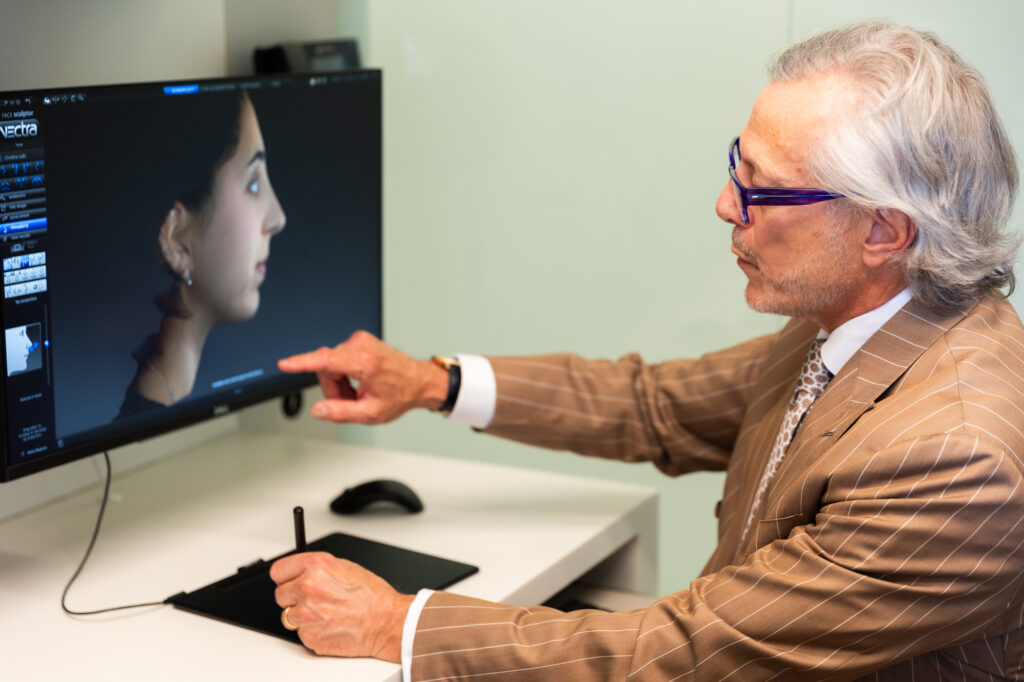
Dr. Pearlman, one of the best nose job surgeons in NYC, shows a patient their 3D imaging results. 3D imaging can be used to better determine a patient's nose reshaping surgery cost in New York City.

Most rhinoplasty surgeries are dedicated to changing the size and shape of the nasal bridge. So “bridge rhinoplasty” can be a somewhat redundant statement.

If you’re interested in bridge rhinoplasty in NYC, consider booking your consultation with Dr. Steven Pearlman, a rhinoplasty specialist.

Types of Nasal Bridge Concerns

The nasal bridge plays a central role in facial balance and overall profile aesthetics. Even subtle irregularities along the bridge can influence how the nose appears in relation to the eyes, forehead, lips, and chin.

Some patients want to soften a prominent dorsal hump, while others may wish to build structure and definition into a naturally flatter bridge. In many cases, nasal bridge concerns are also connected to functional concerns that involve the internal structures of the nose.

Below are some of the most common nasal bridge concerns addressed through our bridge rhinoplasty in NYC.

Nasal Bridge Concern Common Characteristics Potential Rhinoplasty Goals
Dorsal Hump Prominent bump along the bridge Smooth and refine the nasal profile
Low Nasal Bridge Flat or under-projected bridge Improve definition and structure
Crooked Nasal Bridge Visible asymmetry or deviation Create better alignment and symmetry
Wide Nasal Bridge Excessive width across the upper nose Narrow and refine proportions
Post-Traumatic Changes Irregularities after injury Restore balance and structural support


Dorsal Hump or Prominent Bridge

One of the most common reasons patients seek a bridge rhinoplasty in NYC is to address a dorsal hump, which is a visible bump along the bridge of the nose. Bone, cartilage, or a combination of both may cause this hump, and it can vary significantly in size and shape.

Modern rhinoplasty techniques focus on refining the bridge while preserving natural structure to avoid an overly “operated” appearance. Rather than aggressively removing tissue in the nose, Dr. Pearlman creates smoother dorsal lines that maintain balance and support.

Patients seeking dorsal hump reduction often want to address concerns such as:

  • A prominent profile appearance
  • A “hooked” or convex bridge shape
  • Imbalance between the bridge and nasal tip
  • A bridge that appears too strong or dominant for the face

Reducing a nasal hump can be accomplished in a number of ways. Classical reduction includes a rasp (surgical file) and osteotome (surgical chisel). More modern techniques utilize Piezo Ultrasonic rhinoplasty and/or preservation rhinoplasty techniques

Low or Flat Nasal Bridge

A low nasal bridge gets described as “flatter,” particularly in profile view. Some patients feel this leaves reduced facial definition or less separation between the eyes and the bridge area.

Surgeons perform bridge augmentation to improve contour and structure, improving that definition and separation while maintaining natural-looking proportions. To achieve this, your surgeon may use cartilage grafting or other structural techniques during the rhinoplasty procedure.

Patients considering augmentation of the nasal bridge may seek treatment for:

  • Limited bridge definition
  • A flatter facial profile
  • Loss of bridge support due to previous surgery or trauma
  • Desire for improved facial contour while maintaining ethnic identity

At Pearlman Aesthetic Surgery, maintaining individualized facial harmony remains a central priority. We help patients preserve ethnic and personal characteristics while we refine and support the natural anatomy in a balanced way.

Crooked or Deviated Nasal Bridge

A crooked nasal bridge may result from genetics, previous injury, asymmetrical growth, or internal structural deviation. In some cases, patients are primarily concerned about aesthetic asymmetry. In others, the deviation also contributes to functional breathing difficulties.

Correcting a crooked nose is one of the more technically demanding types of rhinoplasty, because it requires careful management of both external appearance and internal support structures.

Treatment may involve reshaping of bone and cartilage, correcting septal deviation, and reinforcing structural stability to improve both alignment and airflow.

Patients with crooked bridge concerns may notice:

  • Visible asymmetry from the front view
  • A nose that appears shifted or twisted
  • Difficulty breathing through one side of the nose
  • Irregular contours after prior injury

Wide Nasal Bridge

A wide bridge can create a heavier appearance through the center of the face and may affect overall facial definition. Bridge narrowing techniques often reposition the nasal bones to create improved contour and proportion.

Common concerns associated with a wide nasal bridge include:

  • Excessive width visible from the front view
  • Imbalance between the bridge and nasal tip
  • A bridge that appears boxy or heavy

Post-Traumatic Bridge Changes

Injuries to the nose can alter both appearance and function. Trauma may lead to irregular bridge contours, collapse, asymmetry, breathing obstruction, or long-term structural instability.

Our bridge rhinoplasty in NYC can take a more reconstructive approach, particularly when prior fractures or untreated injuries have affected the nasal framework.

Depending on the extent of the injury, treatment may involve:

  • Straightening displaced structures
  • Restoring bridge contour
  • Reinforcing weakened cartilage
  • Improving nasal airflow
  • Correcting asymmetry resulting from prior fractures

Who Is a Candidate for Bridge Rhinoplasty?

Patients considering our bridge rhinoplasty in NYC often seek treatment to address concerns involving the contour, symmetry, width, or projection of the nasal bridge.

While many patients make good candidates for the procedure, rhinoplasty is highly individualized, and your eligibility involves more than specific aesthetic concerns.

Your surgeon will typically consider several important factors when evaluating candidacy for surgery.

Your Facial Growth Is Complete

Experts only recommend rhinoplasty after the nose and other facial structures have fully matured. Because the face continues developing throughout adolescence, performing surgery too early may affect long-term results and facial balance.

For many patients, nasal growth usually finishes around age 16 or a little later, though timing can vary depending on the individual. During consultation, Dr. Pearlman carefully evaluates facial maturity before recommending surgery.

You Are in Good Overall Health

Patients considering our bridge rhinoplasty in NYC should be in good overall physical health prior to surgery. Certain medical conditions can increase the risk of complications during surgery, healing, or recovery.

These conditions include:

Patient safety remains the highest priority throughout the surgical process. We review your medical history in detail during your consultation to perform rhinoplasty as safely and effectively as possible.

You Do Not Smoke, or You Are Willing to Stop

Smoking and nicotine use interfere with circulation and can significantly impair healing after surgery. Nicotine use also increases the risk of complications, prolonged swelling, and compromised results during and after the procedure.

We advise patients to stop smoking and avoid nicotine products both before and after surgery.

You Have Realistic Expectations

Our bridge rhinoplasty in NYC can create meaningful improvements in facial harmony and nasal contour, but successful outcomes begin with realistic expectations. Rhinoplasty creates better refinement and balance rather than perfection.

Open communication during your consultation will help establish clear goals and align your expectations with what can realistically and safely be achieved through surgery.

You Feel Emotionally Prepared for Surgery

Rhinoplasty is a deeply personal decision, and emotional readiness is an important part of the process. Patients should pursue surgery for themselves rather than because of outside pressure.

Patients experiencing significant personal stress or major life transitions may benefit from postponing surgery until the timing feels more stable and manageable. Approaching rhinoplasty with a healthy mindset often contributes to a smoother overall experience.

Fixing the Nasal Bridge with Rhinoplasty

There are a number of common concerns that cause patients to seek rhinoplasty for the nasal bridge in NYC. Some of them are:

  • Crooked nose
  • Flat bridge
  • Narrow 
  • Wide
  • Dorsal hump removal
  • High nasal bridge

Dorsal hump removal is probably the most common rhinoplasty request, which involves smoothing out a protruding bridge.

Frequently Asked Questions About Bridge Rhinoplasty

Does bridge rhinoplasty change breathing?

Bridge rhinoplasty can affect breathing, depending on the techniques used and the underlying anatomy of the nose.

In many cases, patients seeking bridge rhinoplasty also have structural concerns that contribute to nasal obstruction. This includes a deviated septum, internal valve collapse, or prior nasal trauma.

Our bridge rhinoplasty in NYC always prioritizes both the aesthetic and function of the nose. A nose requires internal structural support to maintain healthy airflow, which is why modern rhinoplasty techniques also focus on preserving or improving nasal breathing.

When required, your surgeon may combine bridge adjustments with functional corrections to address breathing concerns at the same time.

Can bridge rhinoplasty fix nasal asymmetry?

Bridge rhinoplasty can often improve the appearance of nasal asymmetry, especially significant variance. This technique best applies to aesthetic concerns like a crooked bridge, visible deviation, or irregular contours caused by genetics or a previous injury.

However, complete facial symmetry rarely exists. Most patients have subtle asymmetries throughout the face, and rhinoplasty improves balance rather than creating mathematical perfection.

At Pearlman Aesthetic Surgery, surgical planning is highly individualized, with careful attention given to both aesthetic refinement and structural integrity. Dr. Pearlman shapes a nose that appears natural, proportionate, and harmonious with surrounding facial features.

Can a dorsal hump come back?

Most times, a dorsal hump does not “grow back” after rhinoplasty. Once excess bone and cartilage are carefully reduced and reshaped, the results last permanently.

That said, healing after rhinoplasty is a gradual process, and swelling along the bridge can temporarily obscure the results during recovery. It can take up to a year for swelling to fully subside, so stay patient during the recovery process as your refinements reveal themselves over time.

In rare situations, small irregularities or residual prominence may become visible as healing progresses, Because of this, precise surgical planning and structural preservation are so important during bridge rhinoplasty.

How does rhinoplasty work?

Before scheduling your rhinoplasty in NYC, you’ll meet with Dr. Pearlman for an in-depth consultation. He’ll ask about your medical history and the changes you want to see in your nose.

Then he will perform a full examination of your nose, inside and out. Using advanced Mirror® 2D and Vectra 3D imaging, he will demonstrate the potential changes to your nose to help you envision your future results.

During your consultation, Dr. Pearlman will talk you through which technique will achieve your desired results.

Learn more about the specifics of rhinoplasty surgery

Schedule Your Consultation for Rhinoplasty in NYC

Dr. Steven Pearlman is uniquely dual board-certified in Facial Plastic and Reconstructive Surgery as well as Otolaryngology—Head and Neck Surgery. He’s performed over 7,500 rhinoplasties in his career and has been chosen as a Top Doctor by New York Magazine and Castle Connoly.

As one of the top nose surgeons in NYC, Dr. Pearlman also frequently lectures as a visiting professor on rhinoplasty, revision rhinoplasty, and facial aging throughout the world.

Book Your Consultation

Nothing replaces an in-person consultation. However, for our out-of-town patients, we provide a virtual rhinoplasty tool to explore our available techniques. Answer a few questions, and we’ll send customized recommendations to your inbox.


Virtual Rhinoplasty Consultation